Blog & Insights
How to Set Up B2B Wholesale on Shopify Without Plus (2026 Guide)
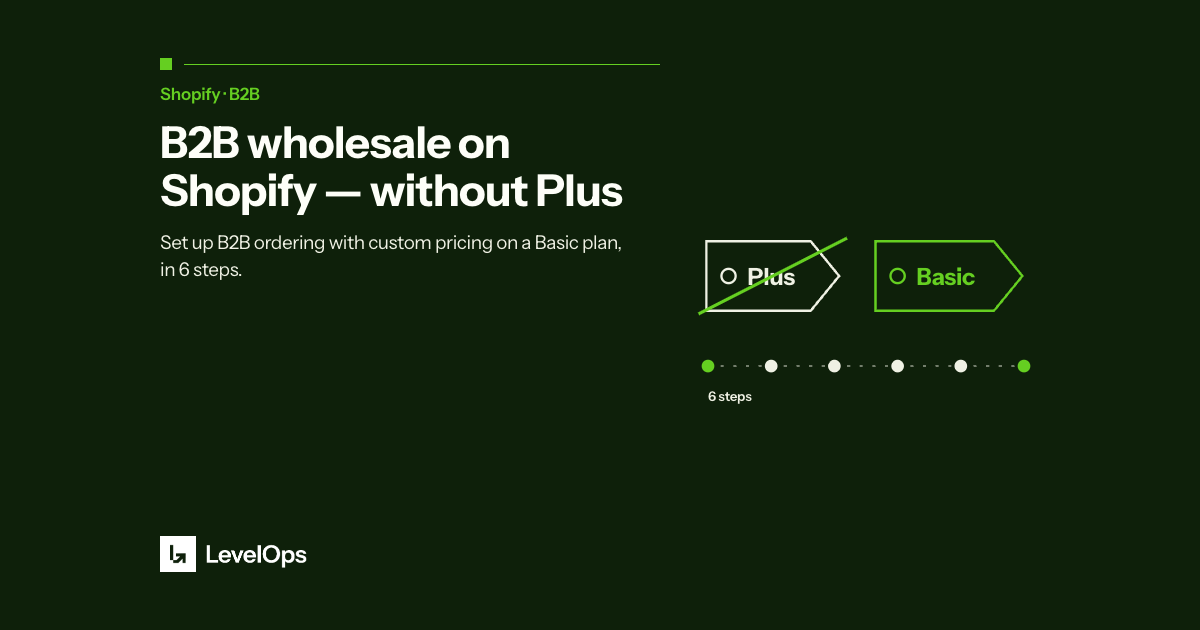
If you sell wholesale on a basic Shopify account, you have probably wondered how to give a customer their own pricing without paying for Shopify Plus. Good news: as of 2026 you can run B2B wholesale on Shopify without Plus, with native custom pricing built right into your admin.
The 2026 change: native B2B, no Plus required
For nearly four years, native B2B on Shopify was locked behind Plus. That changed on April 2, 2026.
What changed: Shopify extended its foundational B2B features to the Basic, Grow, and Advanced plans at no extra cost: company profiles, up to three custom catalogs with wholesale pricing, volume pricing, quantity rules, payment terms, and vaulted credit cards. Source: Shopify, B2B for all.
For most wholesale operations, that means you can set up a real B2B store with custom pricing per customer, no app and no Plus upgrade required.
Set up wholesale ordering with custom pricing, step by step
Here is the full setup, the same one I walk through in the video.
- Use the same product for wholesale and retail. Do not duplicate it. One product keeps your inventory in one place, whether the sale comes from your online store or a wholesale account. No duplicate SKUs to reconcile.
- Create the customer. Add your wholesale buyer as a customer. If several people or locations order from the same company, you group them under one company next.
- Create the company and its locations, then assign your buyers. The company profile holds all of that buyer's contacts, locations, orders, and invoices. Use permissions to control which locations each buyer sees: an admin contact sees every location, while a single buyer can be limited to one, for example only their Atlanta location.
- Create a catalog with that company's pricing. A catalog is just a price list. Set your wholesale prices here once, for example 10% off retail for that client, instead of overriding prices order by order.
- Create a Market and assign the company's locations to that catalog. This is the step most guides miss. On Basic, Grow, and Advanced you cannot attach a catalog directly to a company, that stays Plus-only. A Market links the company's locations to the pricing catalog instead. Create the market, add the locations, point them at the wholesale catalog, and Shopify applies that customer's pricing automatically on every order.
- Automate PDF and email order intake. If your customers still send POs as PDFs or email text, do not hand-key them into draft orders. LevelOps PDF to Order reads any incoming PO, no template and even with no SKU, and creates the Shopify draft order automatically with the right customer, products, quantities, and shipping address. Pricing still comes from the native catalog you just built, so you automate only the typing.
When native B2B is enough, and when you need Plus
- Custom pricing per company
- Up to three price catalogs
- Volume pricing and quantity rules
- Payment terms and saved cards
- Simple to mid wholesale operations
- Four or more price catalogs
- Complex quantity and volume tiers
- Partial payments and deposits
- Catalog assigned directly to a company
If your pricing is relatively clean, the native setup above is all you need. If it is genuinely complex, that is when a wholesale app or a move to Plus starts to pay off.
The short version
You do not rebuild what Shopify already gives you. You use what is there and bridge the gap. Native B2B now handles company accounts and custom pricing on any plan.
The only piece Shopify does not automate is turning a PDF purchase order into an order. That is a five-minute app install.